![Full logo.png]](https://helpdesk.getpinch.com.au/hs-fs/hubfs/Full%20logo.png?height=40&name=Full%20logo.png)
It's first important to understand the different fee structures that the Glassbox fee engine can support, and how these link into the different platforms or services Pinch offers.
A few terms to familiarise yourself with first:
-
Interchange - Is the cost of moving money between the card issuing bank, and the payment acquirer.
-
Scheme (Scheme Fees) - Charged by the schemes (Visa, and Mastercard) as a cost to process the transaction between the numerous banking systems. These fees fluctuate depending
- Acquirer - Is a financial institution that processes credit/debit card payments on behalf of a merchant, acting as an intermediary between the merchant, card networks, and the customer's bank. They enable businesses to accept payments, handle settlements, and manage chargebacks.
Basis Points ('bips' or bps) - is the industry term for a fraction out of 100. So 0.50% would be 50bps. This measure comes in handy when reading IC++ schedules or commercial/wholesale contracts.
This diagram is a helpful one to understand the structure of these charges.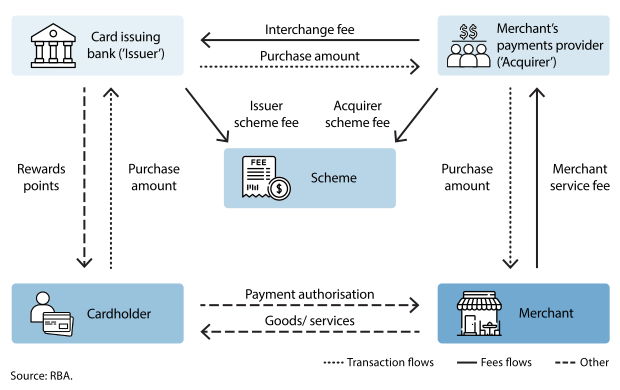
Below are the core fee structures that Pinch offers across the different systems and connection types.
Blended - This is the most common method used by platforms to charge merchant service fees, as all of the complex interchange and scheme fees are calculated by the merchants, and an aggregated fee is charged to the merchant so they have a consistent price, regardless of the card that was used. This is typically expressed as a percentage rate, where the payment facilitator's costs depend on what card and bank the transaction is being processed for, but the end payer always pays the same amount. An example of this is Pinch Payments' standard Merchant Portal pricing for companies using Pinch connected to an accounting system like Xero, with a blended price of 1.95%+30c to process a domestic Visa or Mastercard transaction.Fixed Fee - This fee structure is designed for simplicity and volume. A fixed fee is charged regardless of the transaction size, and allows for platforms or larger enterprise clients to forecast costs more efficiently, depending on the volume and size of transactions. An example of this might be a fixed Direct Debit cost, instead of a percentage of a total transaction, so regardless of size, the cost stays the same. An example of this is ISVs utilising Pinch's API directly may be offered fixed Direct Debits of a $ value, instead of blended pricing.
IC+ (Interchange + Scheme) - This pricing model is one of the most complex and only suits larger enterprise partners or system integrators that need granularity of costs at an enormous scale. This price structure is uncommon and is usually charged via a platform fee or system fee, where transactions are being passed through a system without a markup.
IC++ (Interchange + Scheme + Acquirer Markup) - This pricing model is the most complex, and only suits larger enterprise partners or system integrators that need granularity of costs at an enormous scale. This price structure is designed around a number of basic points, margin for the platform, regardless of scheme and interchange costs. This means that the platform is being passed through those costs based on which card is being processed, and the acquirer's margin is protected to ensure the platform provider (Pinch) doesn't lose money processing a transaction. This granularity ensures the platform has insight into which cards are costing them the most, so they can tailor their clients and system to suit. An example of this might be priced as such: : IC + 0.30% + 30c AUD